
Introduction to Marine Exopolymer Particles
Since their identification in the 1990s, gel-like exopolymer particles have emerged as critical components of marine biogeochemical cycles. Among these, Coomassie Stainable Particles (CSP) represent a distinct class of organic particles enriched in proteins. These particles were first observed in marine environments such as the Pacific coastal waters and the Arabian Sea, where they were detected using filtration and staining techniques based on Coomassie Brilliant Blue dye.
CSP are operationally defined as particles retained on fine-pore filters and subsequently stained by protein-specific dyes. Because they are not visible under standard light microscopy without staining, their detection relies heavily on biochemical labeling methods. Their protein-rich composition differentiates them from other exopolymer particles and suggests a unique ecological and biochemical role in the ocean.
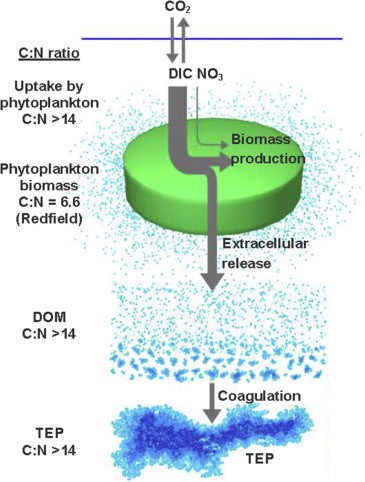
CSP vs Other Marine Exopolymers
Transparent Exopolymer Particles (TEP)
The most extensively studied exopolymers in marine systems are Transparent Exopolymer Particles (TEP). These particles are primarily composed of acidic polysaccharides and are stained using Alcian blue dye. TEP are widely recognized for their role as “biological glue,” facilitating the aggregation of organic matter into marine snow, which contributes to carbon export to deeper ocean layers.
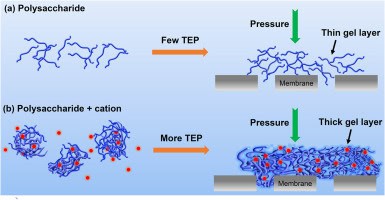
Differences Between CSP and TEP
Although CSP and TEP share similar sizes and can coexist in marine environments, they differ significantly in composition and behavior:
- CSP: Protein-rich particles detected via Coomassie staining
- TEP: Polysaccharide-rich particles detected via Alcian blue
- Function: TEP promotes aggregation, while CSP appears more dynamic and degradable
- Biogeochemical role: CSP may contribute more to nitrogen cycling due to higher protein content
Current evidence suggests that CSP and TEP represent distinct but partially overlapping particle populations, rather than a single unified class.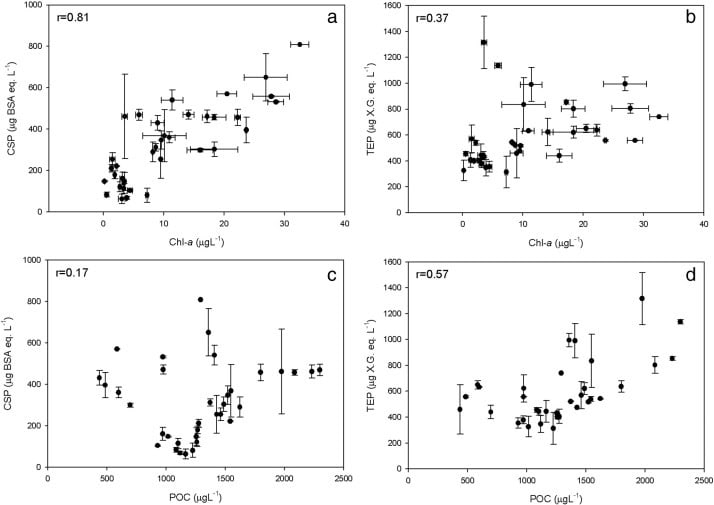
Methods for Detection and Quantification of CSP
CSP are typically analyzed through:
- Filtration onto polycarbonate membranes
- Staining with protein-binding dyes
- Microscopic imaging and digital image analysis
These methods allow researchers to estimate:
- Particle abundance (number per liter)
- Particle concentration (surface area per volume)
While image-based techniques provide valuable insights, they rely on two-dimensional representations of particles that are naturally three-dimensional in seawater, introducing some limitations in accuracy.
Alternative detection techniques include:
- Immunochemical assays
- Fluorescent staining methods targeting calcium-linked polymers
However, these methods are less commonly used and may not specifically distinguish CSP.
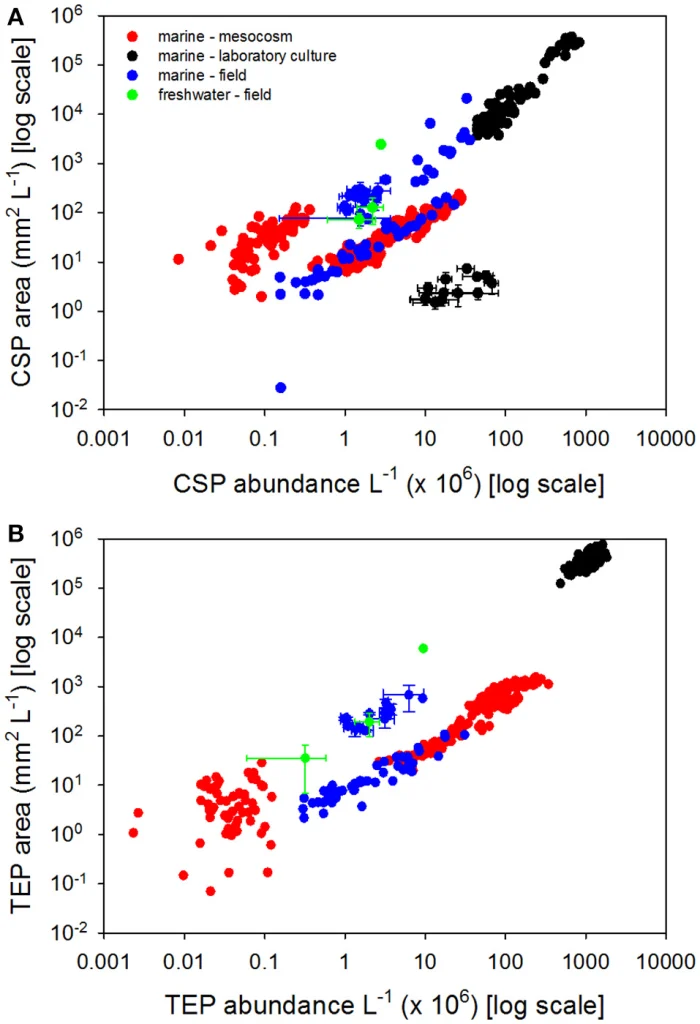
Distribution and Abundance in Marine Environments
Field studies indicate that CSP are widely distributed across marine ecosystems, including:
- Atlantic Ocean
- Pacific Ocean
- Arabian Sea
- Arctic Ocean
They are particularly abundant in the upper ocean layers, including the sea surface microlayer (SML), a biologically active interface between ocean and atmosphere.
CSP concentrations vary widely depending on environmental conditions, sometimes spanning several orders of magnitude. This variability reflects the dynamic nature of biological production, degradation, and aggregation processes in the ocean.
Importantly, CSP have also been detected at great depths, suggesting they are not limited to surface production and may play a role throughout the entire water column.
Biological Sources and Formation Mechanisms
Primary Producers of CSP
CSP are primarily derived from:
- Phytoplankton, especially diatoms
- Cyanobacteria
- Heterotrophic microorganisms
These organisms release dissolved organic matter, including proteins, into the surrounding water, which can subsequently aggregate into CSP.
Formation Processes
CSP formation may occur through:
- Biological secretion of protein-rich compounds
- Abiotic self-assembly of dissolved organic molecules into gel-like structures
- Physical processes, such as:
- Bubble scavenging at the ocean surface
- Shear forces and turbulence
- Surface interactions at the air-sea interface
The formation of thin, sheet-like CSP structures suggests that surface processes play a critical role, especially in the sea surface microlayer.
Ecological and Biogeochemical Importance
Role in Carbon and Nitrogen Cycling
CSP are particularly important because of their high nitrogen content, which distinguishes them from carbohydrate-rich particles like TEP. This makes CSP:
- A potential nutrient source for marine microbes and grazers
- A contributor to nitrogen cycling in marine ecosystems
- A factor influencing the carbon-to-nitrogen ratio of organic matter
Interaction with Marine Food
Due to their composition, CSP may:
- Serve as substrates for bacterial growth
- Be consumed by protists and small marine organisms
- Influence microbial community structure
Contribution to Marine Snow and Carbon Export
Although less studied than TEP, CSP may also contribute to:
- Particle aggregation
- Formation of sinking organic matter
- The biological carbon pump, which transports carbon from surface waters to the deep ocean
However, their exact role in aggregation and sinking processes remains unclear.
CSP in the Atmosphere and Climate System
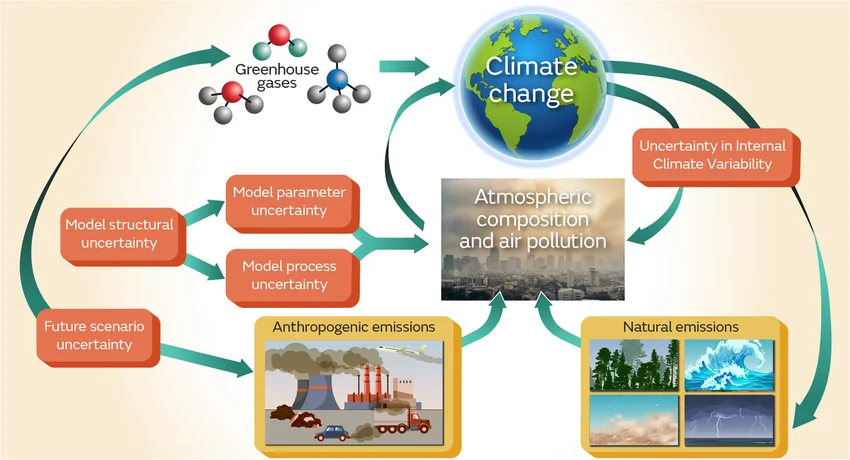
Recent research highlights a potential link between CSP and atmospheric processes. Marine aerosols generated by wave action can transport organic particles, including CSP, into the atmosphere.
These particles may:
- Act as cloud condensation nuclei (CCN)
- Influence cloud formation and climate regulation
- Affect the Earth’s radiative balance
The enrichment of CSP in sea spray aerosols suggests that air-sea exchange processes play a key role in their global impact.
Challenges in CSP Research
Despite growing interest, several challenges limit our understanding of CSP:
- Difficulty in separating CSP from other organic particles
- Lack of standardized quantification methods
- Limited knowledge of molecular composition
- Inability to directly convert staining intensity into biochemical concentrations
Additionally, current methodologies may inadvertently include biological material such as cells and debris, complicating interpretation.
Future Research Directions
To fully understand CSP and their role in marine systems, future studies should focus on:
1. Quantitative Biogeochemical Measurements
Develop methods to measure CSP in terms of carbon and nitrogen content.
2. Improved Detection Techniques
Combine multiple staining and imaging approaches to better characterize particle composition.
3. Molecular Characterization
Use advanced tools such as:
- Mass spectrometry
- Proteomics
- Exometabolomics
to identify the biochemical makeup of CSP.
4. Ecological Function Studies
Investigate:
- CSP production under environmental stress
- Interactions with microorganisms
- Their role in aggregation and sinking processes
5. Expanded Field Observations
Increase sampling across:
- Different ocean depths
- Diverse geographic regions
- Seasonal cycles
Conclusion
Coomassie Stainable Particles represent a significant yet underexplored component of marine organic matter. Their protein-rich composition, widespread distribution, and potential involvement in both oceanic and atmospheric processes make them a key subject in modern marine science.
Understanding CSP is essential for improving our knowledge of:
- Ocean biogeochemistry
- Microbial ecology
- Climate-related processes
As analytical technologies advance, CSP research is expected to play an increasingly important role in unraveling the complexity of marine ecosystems.